Coal Storage
- Large storage capacity
- Saving valuable space
- Environmentally safe
- Fully automated
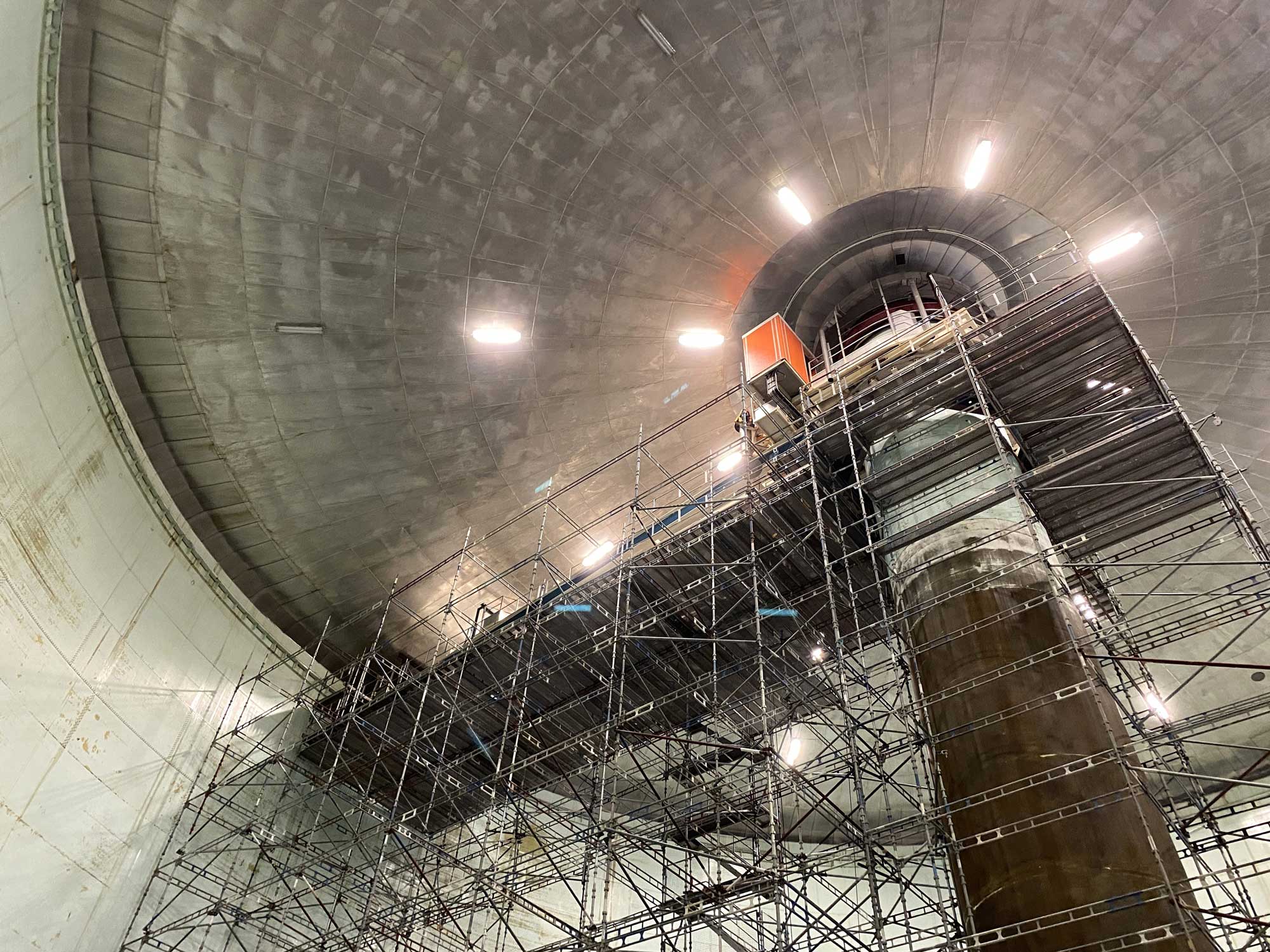
Conventional open stockpile storage requires valuable space, involving environmental drawbacks and loss of calorific value. Enclosed silo storage solves these problems at the smallest possible footprint. The Eurosilo system offers safe storage up to 100,000 m³ per unit. The material is fed from the top into a chute through which it reaches an auger frame on the coal surface. Screw conveyors distribute the material evenly while the auger frame rotates. The stored material is discharged at the bottom, while the screw conveyors rotate in reverse to feed coal into the formed core flow.
Case Study – Lünen Coal-Fired Power Plant
The Trianel coal fired power plant in Lünen is with 750MW output, the most efficient and cleanest coal fired power plant in Europe. The coal is unloaded by cranes at the plant and stored dust-free into the two Eurosilos that offer a total capacity of 200,000 tons, enough to operate the plant for about 30 days at full load. Dust emissions are virtually eliminated by using fully enclosed conveyor systems. Read more about the award winning environmental performance.

Fuel Management maximizes revenue
Your thermal power plant will achieve the highest efficiency rate by burning the optimal coal blend. To prepare the right blends, the ESI Fuel Management System offers great help. The software visualizes the different grades of coal in respective silos and enables the operator to plan coal blending in the optimal way. Boiler specifications, coal characteristics and measured storage levels provide input for the Fuel Management System. Reclaiming different coal grades from respective silos at a controlled rate, gives you the optimal coal blend. Significant operational cost savings reduce the Payback Period, due to minimal maintenance and fully automated handling.
Lifecycle assessment with EMA
To ensure long-term return on investment, it is vital to achieve cost-effective compliance with environmental regulations and self-imposed policies. Environmental Management Accounting (EMA) integrates environmental, operational and maintenance data into financial analysis. The integrated lifecycle assessment, as recognized by the European Community, offers a complete evaluation.

- Minimal footprint for large scale storage
- Safest storage method in the market
- No pollution or loss of calorific value
- Maximum logistic control & flexibility
- Minimal operating and maintenance costs
- High availability due to minimal downtime
FAQ
While timelines vary based on site preparation and location, a project of this scale typically requires 18 to 24 months from the initial engineering phase to final commissioning and operational handover.
Depending on the required storage capacity, available ground space and regulatory limitations, the diameter of a coal silo can vary from 40 to 55 meter and a height of up to 55 meter. Each silo is tailored to match specific requirements.
Yes, the Eurosilo coal storage solutions comply with all international safety standards, including ATEX directives for explosive atmospheres. This includes specialized venting, dust suppression systems, and spark-resistant materials for all moving internal components.
The Eurosilo comes with multiple safety systems, including an air monitoring system that measures carbon monoxide, methane and oxygen. By monitoring the concentration of carbon monoxide any hotspots can be detected an early stage. Other built-in systems prevent the influx of air, while the horizontal screw conveyor continuously moves the coal in layers.
Yes, unlike open stockpiles where wind, rain, and oxidation can reduce the energy density of coal by up to 5-10% over time, the enclosed Eurosilo maintains the coal’s original calorific value by preventing weathering and moisture absorption.
Maintenance is minimal due to the automated design, but we recommend annual inspection of the screw conveyor flights for wear and a biannual check of the central bearing and drive units. Your technical staff will be trained, supervised and supported by our technical specialists.
The system features redundant safety protocols and emergency discharge options. Because the distribution frame with screw conveyors stays on top of the coal, all mechanical components remain accessible, avoiding the need to empty the silo for most maintenance tasks.