Petcoke Storage
- Large storage capacity
- Saving valuable space
- Environmentally safe
- Fully automated
The Eurosilo system is well suited for storing all available grades of petroleum coke, including green coke and calcined coke at anode plants. The fully enclosed Eurosilo systems are in operation at terminals, refineries and power stations around the world. Cost savings, logistic performance and solving environmental issues are the key drivers that lead to the innovative Eurosilo system.
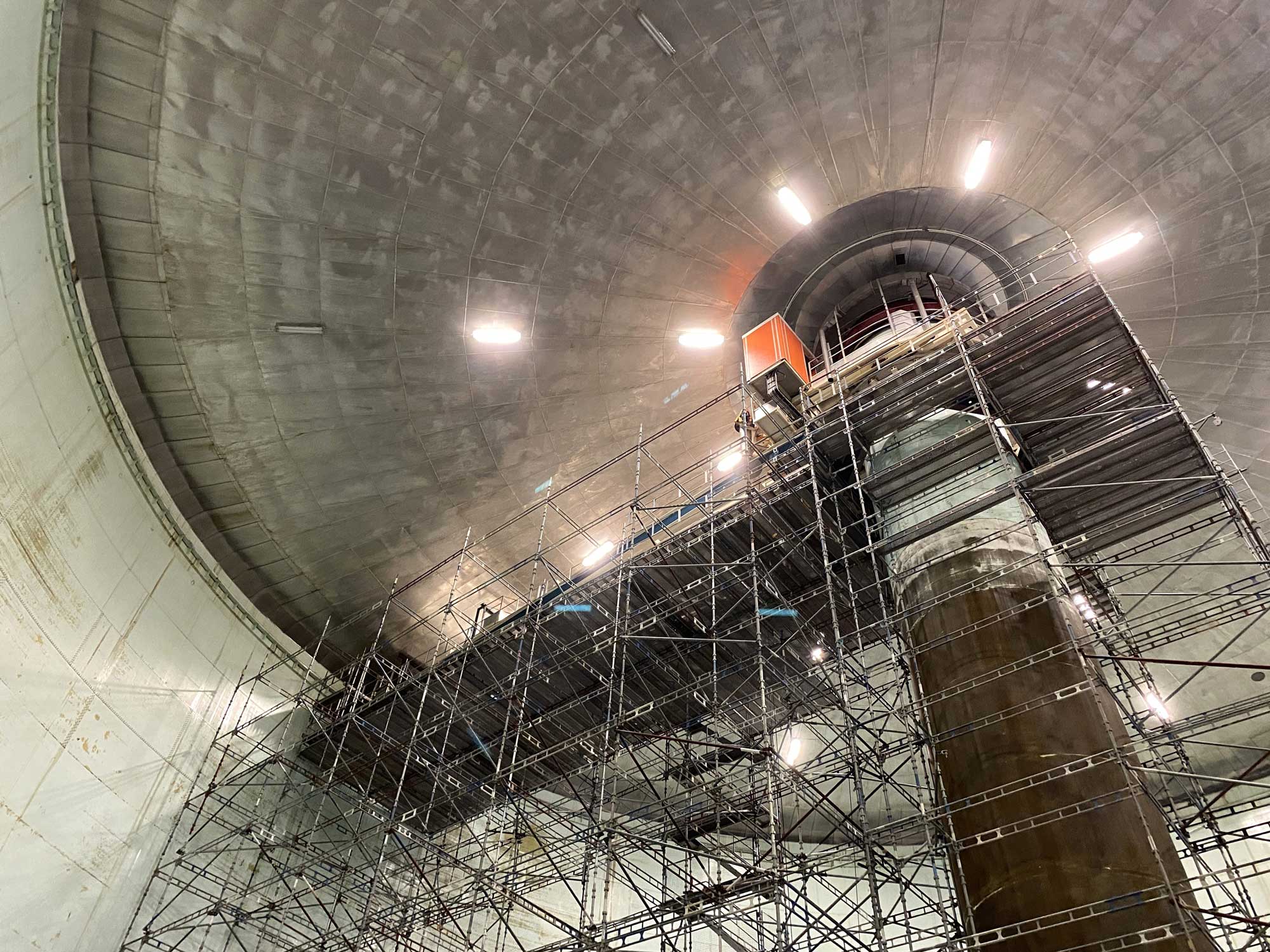
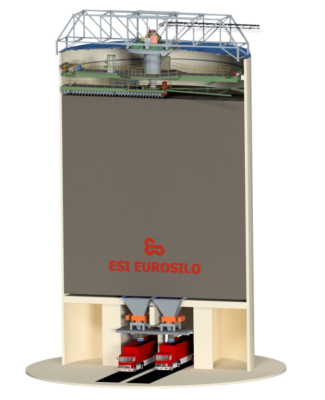
The Eurosilo system offers safe storage up to 100,000 m³ per unit. The material is fed from the top into a chute through which it reaches an auger frame on the petcoke surface. Screw conveyors distribute the material evenly while the auger frame rotates. The stored material is discharged at the bottom, while the screw conveyors rotate in reverse to feed petcoke into the formed core flow.
Case Study – Petcoke Storage
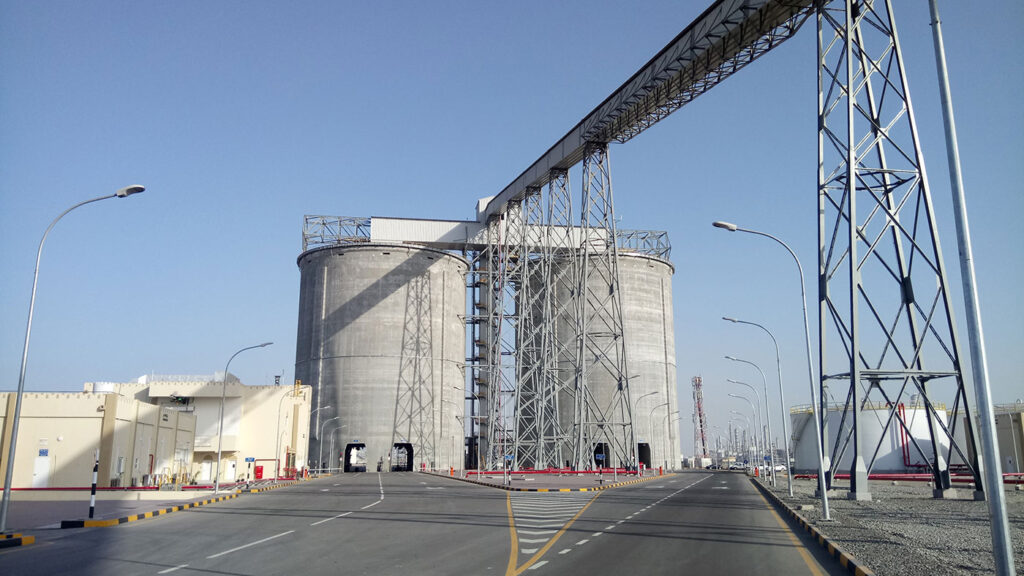
Oman’s Oil Refineries and Petroleum Industrial Company (Orpic) had awarded Larsen & Toubro an EPC contract for petcoke handling and storage in Sohar. Following Orpic’s strong commitment to safety and sustainability, Larsen & Toubro chose the Eurosilo system. Two Eurosilos of 42,000 m3 each, now streamline the logistic flow between the production of petcoke and the periodic loading of the transport ships at the nearby port. The project received the Best EPC PROJECT AWARD 2017.
Dust and fire protection
The combination of dust suppressing extraction and an extensive air tight enclosure of the silo contents eliminates the risk of hotspots, fire or even explosion. The dust suppressing infeed is achieved by keeping the petcoke contained within the telescopic loading chute. Additionally dust extraction system or water vaporizers can be installed at the inlet of the silo. At the auger frame, close to the coke surface, and at the silo roof area, as well as in the conveyor gallery (roof and basement) CO and CH4 detection sensors are installed. Based on the gas monitoring system potential fire risks can be detected in any early stage and measurements can be taken.
Lifecycle assessment with EMA
To ensure long-term return on investment, it is vital to achieve cost-effective compliance with environmental regulations and self-imposed policies. Environmental Management Accounting (EMA) integrates environmental, operational and maintenance data into financial analysis. The integrated lifecycle assessment, as recognized by the European Community, offers a complete evaluation. Significant operational cost savings reduce the Payback Period, due to minimal maintenance and fully automated handling.
- Controlled storage and reclaiming
- Maximum logistics control and flexiblity
- No product degradation
- High availability due to minimal downtime
- Safety measures according to ATEX standards
- Fully automated operation
FAQ
Yes, the system is designed to handle various temperature grades. However, for high-temperature applications, we integrate heat-resistant seals and monitoring sensors to ensure structural integrity and safety during the cooling phase within the silo.
The EMA analysis shows a lower Total Cost of Ownership (TCO) of the Eurosilo than open-air storage. It includes product loss due to wind/rain, ground pollution costs and reduced labor and fuel costs associated with traditional front-end loader operations.
The Eurosilo system includes mechanical safeguards and can be equipped with uninterruptible power supplies (UPS) for the monitoring systems. While resting in a gravity-stable state, the petcoke remains safe. The auger system simply resumes its position once power is restored.
No, the system is designed to be integrated into your facility’s central Distributed Control System (DCS). Once programmed, the loading and reclaiming sequences run autonomously, requiring only remote monitoring from your main control room.
The gas detection sensors (CO and CH4) and temperature monitoring cables are placed in the roof area and conveyor galleries, so they remain accessible. Critical components are designed for easy access from external walkways or the central column to enable maintenance without emptying the silo.
Absolutely. The Eurosilo bottom discharge system is designed to interface directly with underground tunnel conveyors, rail loading stations, or jetty-bound belts, allowing for a seamless high-capacity transfer to your existing transport infrastructure.
While timelines vary based on capacity and location, a standard Eurosilo project typically spans 18 to 24 months. This includes the engineering phase, manufacturing of the proprietary internal components, on-site assembly and mounting inside the silo structure.
The Eurosilo system utilizes a rotating auger frame and screw conveyors that actively feed the material into a central core flow. This mechanical agitation prevents the formation of bridges or ‘rat-holing,’ ensuring a consistent and reliable discharge even with cohesive green coke.